
Where to Find Gold: Reading a Stream, Finding Open Ground and Checking Claims
CoilAndCoin is reader-supported. If you buy through our links we may earn a commission at no extra cost to you. As an Amazon Associate we earn from qualifying purchases. Disclosure.
Prospecting is half geology and half paperwork. Here's what the U.S. Geological Survey and state and federal guides say about both.
Placer vs lode
USGS describes two kinds of gold deposits. Lode gold is still locked in rock veins. Placer gold has eroded out of that rock and been concentrated by gravity, usually in streams. Pans, sluices and most hobby detecting go after placer gold.
Reading a stream
- Bedrock. USGS says gold in streams is often on or near bedrock, because it moves downward during high water, when the whole bed of sand, gravel and boulders is moving.
- Where water slows. USGS: fine gold collects in pockets in sand and gravel bars where the current slackens. The Chugach guide says to check slower water below rapids and falls, deep pools, and the downstream side of boulders.
- Inside bends and bar heads. The Chugach guide calls out inside bends of meanders and the upstream ends of sand or "point" bars for fine gold that's renewed each year during runoff.
- Cracks and roots. Bedrock crevices act as natural riffles (Chugach). New Mexico's list adds potholes and gold trapped under boulders and tree roots.
- Black sand. USGS says prospectors look where coarse sand and gravel have piled up and where black sands have settled out with the gold.
- Timing. The Chugach guide says spring, early summer and just before freeze-up are good, when water is low and gravel is exposed.
Shape is a clue too: the Chugach guide says rough nugget gold is near its source, while flat, smooth gold has traveled.
Is it open? Checking for claims
This is the step beginners skip. The Black Hills National Forest puts it bluntly: most easy-to-find deposits are already claimed, and entering a claim without permission is claim jumping.
- Search BLM's MLRS. BLM says its Mineral & Land Records System has replaced the old LR2000 system and has a research map. The Black Hills NF says it shows claims to the nearest quarter section.
- Check county records and look for claim markers on the ground (Black Hills NF).
- Know what a claim means. Stanislaus National Forest says a claim doesn't grant title to the land; you can still hike, camp or fish there. But you can't pan on an existing placer claim, and BLM says collecting on a claim is prohibited without the claimholder's permission.
- Call the local office. Rules differ forest by forest and field office by field office.
National parks are off limits too; New Mexico's Bureau of Geology says gold panning isn't allowed in national parks. More in metal detecting and prospecting laws.
Recreational panning areas
Some agencies set aside ground just for recreational panners. Examples we confirmed on official pages: BLM's White Mountains area in Alaska lists a gold-panning area at Nome Creek, and the Chugach National Forest guide lists stretches of Bertha, Sixmile, Resurrection and Crescent creeks on the Kenai Peninsula that are closed to mining claims and open to recreational panning. That guide dates from about 2010, so ask the local office whether a site is still open before you go.
What you can keep
BLM's "Can I Keep This?" page says you may collect reasonable amounts of minerals, including gold, for personal use, not for sale or barter.
Safety
- Stream banks: the Chugach guide says not to dig in banks; they can collapse without warning, and digging adds silt that harms fish. Return moved rocks to where they were.
- Old mines: New Mexico's guide says stay out of mine adits and shafts.
- Mercury: USGS says mercury left over from historical gold mining is a potential risk to people and the environment, and that it still turns up in small-scale dredging in California. No agency guide we found covers what to do if you find it. Our suggestion: don't handle or heat it, and contact your state environmental or health agency.
- Cold water and flash floods: New Mexico warns about hypothermia and flash floods in dry washes. Tell someone where you're going.
Gear and further reading
Ready to go? See how to pan for gold, panning kits, sluice boxes and gold detectors. A field guide helps too.
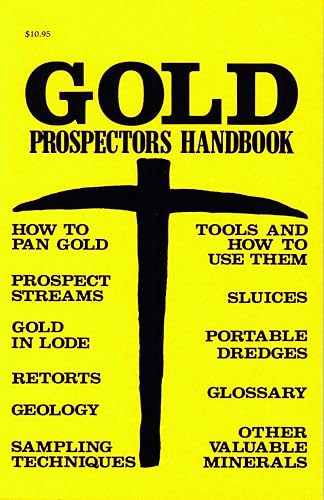
Gold Prospectors Handbook (book)
- Book covering where to look, stream flow, panning and tools, per the description
This isn't legal advice. Confirm claims and rules with BLM, the Forest Service or the landowner before you dig.
FAQ
Where does gold collect?
Near bedrock and wherever the current slows.
How do I check for claims?
BLM's MLRS, county records and claim markers.
Can I keep what I find?
Reasonable amounts for personal use on BLM land; not on someone's claim.
Sources
- USGS: Gold
- USFS Chugach NF and BLM: Gold panning guide (PDF)
- New Mexico Bureau of Geology: Gold panning in New Mexico (PDF)
- BLM: Mineral & Land Records System (MLRS)
- BLM: Can I keep this?
- USFS Black Hills NF: Gold panning, rockhounding and metal detecting
- USFS Stanislaus NF: In search of gold (PDF)
- BLM: White Mountains (Nome Creek)
- USGS: Mercury contamination from historical gold mining in California (PDF)