
Waterproof and Beach Metal Detectors: Depth Ratings and What They Mean
CoilAndCoin is reader-supported. If you buy through our links we may earn a commission at no extra cost to you. As an Amazon Associate we earn from qualifying purchases. Disclosure.
"Waterproof" on a detector can mean a splash-proof control box, a submersible coil, or a fully submersible machine. Below is what each maker rates its models for, plus Garrett's advice on hunting the beach. None of it comes from our own testing.
Depth ratings (official)
| Detector | Rated | Source |
|---|---|---|
| Garrett AT Pro | Fully submersible to 10 ft (3 m) | Garrett |
| Garrett AT Max | Fully waterproof to 10 ft (3 m) | Garrett |
| Minelab X-Terra Pro | 5 m (16 ft), IP68 | Minelab |
| Minelab Manticore | 5 m (16 ft), IP68 | Minelab |
| Minelab Vanquish 360 | 5 m (16 ft), IP68 | Minelab |
| Nokta Simplex Ultra | 5 m (16 ft), IP68 | Nokta |
| Minelab Vanquish 340 | Coil only, 1 m (3.3 ft) | Minelab |
| Garrett ACE 400 | Coil only; housing not submersible | Garrett manual |
Treat these ratings as limits, not targets. The Vanquish 340 link is a bundle with a carry bag (swapped in Oct 2026 when the plain listing went dead).
Saltwater and the beach (Garrett)
- Technology: Garrett says mineralized soil and saltwater are VLF's weak spots. Pulse induction handles saltwater and mineralization but offers less discrimination; single or simultaneous multi-frequency detectors give more Target ID but should have good ground balance and salt elimination. Minelab says Multi-IQ minimizes ground noise, especially in saltwater.
- Dry sand is the most stable area and, per Garrett, one of the best spots for beginners.
- Wet sand is harder because of mineralization and salt water.
- The waterline requires waterproof equipment. Low tide exposes more beach, and storms can shift sand.
- Rules: Garrett says many beaches have local rules that restrict or ban detecting, and to fill any holes and remove trash. See metal detecting laws.
Choosing a detector for the beach
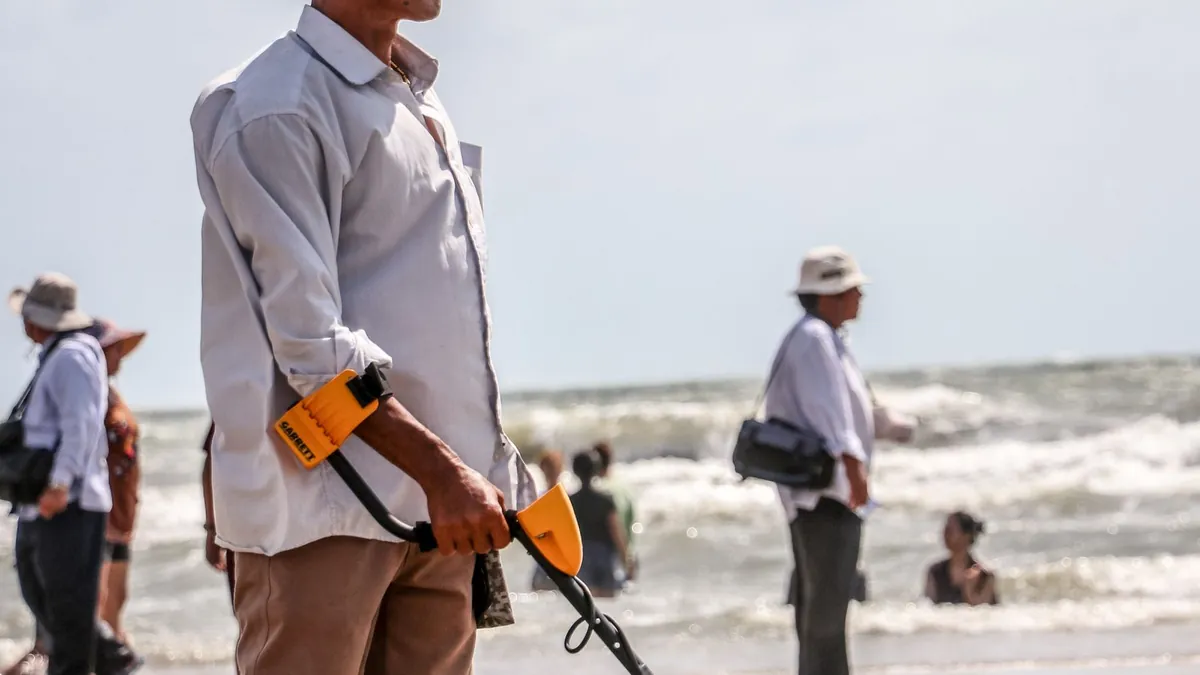
"Beach" covers three different places, and the right machine depends on which one you'll hunt most. Garrett calls dry sand the most stable area and one of the best spots for beginners; wet sand is harder because of salt and mineralization; and the waterline and surf need fully waterproof gear. Here's how the models on this page line up, using each maker's own specs.
| Detector | Technology (maker) | Beach setting (maker) | Waterproof | Best fit |
|---|---|---|---|---|
| Minelab Vanquish 360 | Multi-IQ simultaneous multi-frequency | Beach mode | IP68, 5 m (16 ft) | Dry and wet sand, wading |
| Minelab Vanquish 460 / 560 | Multi-IQ | Beach mode plus Park, Field and a User Profile | IP68, 5 m (16 ft) | Wet sand and surf; more control in trash |
| Minelab X-Terra Pro | Selectable single frequency | Beach 1 and 2 at 8 kHz | IP68, 5 m (16 ft) | Dry sand and shallow water |
| Minelab Manticore | Multi-IQ+ | Beach modes among 10 search modes | IP68, 5 m (16 ft) | Serious wet-sand and surf hunting |
| Garrett AT Pro | Single frequency VLF | No dedicated salt mode listed | 10 ft (3 m) | Dry sand, fresh water |
| Nokta Simplex Ultra | Single frequency, 15 kHz | Beach mode | IP68, 5 m (16 ft) | Dry sand and fresh water |
The pattern follows Garrett's explanation: single-frequency VLF detectors are at their weakest in salt water and wet salty sand, so for a saltwater beach a simultaneous multi-frequency machine (or pulse induction) is the safer buy. On a freshwater lake beach or in dry sand, a single-frequency detector with a beach mode works fine.
A note on the Vanquish line: Minelab has replaced the Vanquish 340 (coil-only waterproofing to 1 m) with the 360, 460 and 560, which are all fully submersible to 5 m. The 340 bundle in the table above is the previous generation and is selling out (Oct 2026). See Vanquish 360 vs 460 vs 560 for how the three new models differ.
Lost something on the sand rather than hunting for it? Our guide to finding a lost ring covers search patterns for dry sand, wet sand and the surf.
Garrett AT Pro and AT Max
The AT Pro lists 40 levels of iron discrimination, a 0-99 Target ID and an 8.5 x 11 inch DD coil, with MS-2 headphones. The AT Max lists 13.6 kHz, True All Metal mode, a backlit display and Z-Lynk wireless headphones. Both are rated to 10 feet. Full details in our AT Pro guide.

Garrett AT Pro Metal Detector
- Waterproof to 10 ft
- 40 levels of iron discrimination
- Proportional audio and Iron Audio; digital Target ID
- MS-2 headphones included
Garrett AT Max Metal Detector
- 13.6 kHz operating frequency
- Fully waterproof to 10 ft; backlit display
- True All Metal mode and Iron Audio
- Z-Lynk wireless headphones included
Minelab X-Terra Pro, Vanquish 360 and Manticore
The X-Terra Pro has a dedicated 8 kHz beach frequency per Minelab and is rated to 16 feet. The Vanquish 360 listing describes Multi-IQ, a Beach mode and full submersion to 16 feet. The Manticore lists 10 search modes including Beach, rated to 16 feet. More in our Minelab comparison.
Minelab X-Terra Pro
- Selectable frequencies (Pro-Switch)
- IP68 waterproof to 16 ft
- 2x Park, 2x Field and 2x Beach modes; 30 discrimination segments
- Flashlight, backlit display, handgrip vibration; 2.9 lb
Minelab Vanquish 360
- Multi-IQ, fully automatic
- IP68, submersible to 16 ft
- Park, Beach and All Metal modes
- Rechargeable battery, up to 10 hours; V10X 10x7 in. DD coil; 2.6 lb
Minelab Manticore
- Multi-IQ+ simultaneous multi-frequency
- 2D Target ID map
- 10 search modes including Beach and Goldfield
- Waterproof to 16 ft (IP68); 11 in. DD coil; folds to 24.8 in.
Nokta Simplex Ultra
15 kHz, IP68 to 16 feet, 2.6 pounds, with vibration for underwater use, according to Nokta and the listing.
Nokta Simplex Ultra
- Fully waterproof to 16 ft (5 m)
- Carbon fiber shaft; retracts to 25 in.
- Online firmware updates via USB
- 2.6 lb; Bluetooth headphones not included; 11 in. coil
Beach recovery gear
A waterproof detector is only half the kit. Match the rest to the same depth: a sand scoop sifts out targets without digging by hand, and a waterproof pinpointer helps find them in wet sand (Garrett's Pro-Pointer AT is rated to 20 feet; compare others in our pinpointer guide). Headphones are the part people forget: Garrett lists its MS-2 headphones as non-submersible, even the version with the underwater AT connector, so check the headphone compatibility table before you wade in.
Stainless Sand Scoop with Long Steel Handle
- 11 x 6 x 3.74 in. stainless scoop with 8 mm holes
- 1.8 lb with short handle; about 3.2 lb with long handle
- Detachable short handle plus 3-part long handle
Garrett Pro-Pointer AT
- Submersible to 20 ft
- 3 sensitivity levels; fast retune
- One-button control; stealth mode
- Molded inch/cm ruler; lanyard loop
More fully waterproof options
Minelab's Equinox 700 and Garrett's Vortex VX9 are both listed waterproof to 16 ft. We compare them against their siblings in Equinox 700 vs 900 and Vortex VX5 vs VX7 vs VX9, and Nokta's options in Double Score vs Simplex Ultra.
Minelab Equinox 700
- Multi-IQ or 4 single frequencies
- Waterproof to 16 ft (5 m)
- Park, Field and Beach modes
- EQX 11 in. DD coil; wireless headphones; 2.8 lb
Garrett Vortex VX9
- 5, 9, 13, 18 and 25 kHz single frequencies or multi-frequency
- Submersible to 16 ft (5 m)
- 2.9 lb; collapses to 24.75 in.
- Internal battery, up to 15 hours; USB-C
FAQ
How deep can they go?
10 ft for Garrett's AT series; 16 ft for X-Terra Pro, Manticore and Simplex.
Which handles saltwater?
Multi-frequency with salt handling, or PI; Garrett says VLF struggles.
Waterproof coil vs waterproof detector?
Not the same. Check whether the control box is rated too.
Sources
- Garrett: A guide to metal detecting on the beach
- Garrett: Types of metal detectors
- Garrett: AT Pro specs
- Garrett: AT Max specs
- Minelab: X-Terra Pro specs
- Minelab: Manticore specs
- Nokta: Simplex Ultra
- Minelab: Equinox technologies
- Garrett: ACE 400 owner's manual (PDF)
- Minelab: Vanquish 340 specs
- Minelab: Vanquish 540 specs
- Garrett: MS-2 headphones, 2-pin underwater AT connector
- Minelab: Vanquish 360 tech specs
- Minelab: Vanquish 460 tech specs